

Instruments for Measuring Viscosity
One way of measuring viscosity of paint is through the use of Dip cups and Flow cups. These are cups made in accordance to the specification provided in the respective standards. The usual report for these cups indicate the Efflux time in seconds but the majority of the standards provide formulae for the conversion of the Efflux time for each type of cup and its orifice size.
For example, ASTM D4212 for the Zahn cup gives the formula of V = 1.1 (t – 29) for the Zahn Cup Number 1 cup, where V is the Kinematic viscosity in Centistokes and t is the Efflux time in seconds.
The Efflux time is the time from when the cup is lifted clear of the paint surface until the moment when there is a break in the steady flow of the stream of paint coming out of the orifice at the base of the cup.
Dip Cups
How to use Dip Cups
1. Immerse the cup completely into the liquid and twist several times to dislodge any bubbles which may be clinging to the internal surface of the cup (Figure A).
2. Stir the liquid gently to ensure uniform temperature and density.
3. Leave the cup in the liquid for one to five minutes: For a Zahn cup (which has a low mass) one minute will be sufficient; for cups with higher mass, five minutes will be better.
4. Lift the cup vertically out of the liquid (Figure B) and start the stopwatch the moment the top of the cup breaks the surface of the liquid.
5. Watch the flow of liquid from the orifice and stop the stopwatch the moment the flow breaks.
When using a Lory LCH Viscosity Dip Cup (Elcometer 2215), observe the surface of the liquid and stop the stopwatch the moment the top of the needle appears.
The three types of dip cups that depend on Efflux times are:
Frikmar (DIN 53211 for cup number 4 only)
Zahn (ASTM D4212)
Shell (ASTM D4212)
They are used in the same way and the conversion into Centistokes (cSt) are in accordance with the guidelines in the respective standards.
There is a faster way to determine the viscosity in Centistokes and this is by way of using Elcometer’s ElcoCalc Mobile App.
Another type of Dip cup is the Lory cup but its method of use is slightly different: instead of determining the Efflux time, it is the time that takes the paint to travel through the hole until the top of a needle (inside the cup) can be seen.
Flow Cups
There are several types of Flow Cups:
ISO (ISO 2413)
BS (BS3900-A6)
FORD/ASTM (ASTM D1200)
DIN (DIN 53211, CUP 4 only)
AFNOR (NF T30-014)
How to use Flow Cups
1. Place the cup into the stand and level the cup using the glass plate and bubble level supplied with the stand (Figure A).
2. Allow the temperature of the cup and the sample to stabilise at the agreed temperature. Check the temperature of the sample before filling*.
3. Place a finger over the cup orifice to close the orifice (Figure B).
4.Pour the liquid gently into the cup, avoiding the formation of air bubbles (Figure B).
5. Slide the glass plate over the rim of the cup to remove excess sample. Avoid the formation of air bubbles between the glass plate and the liquid (Figure C).
6.Remove your finger from cup orifice and wait for a few minutes to allow any air bubbles to rise to the top of the liquid.
7. Remove the glass plate and start the stopwatch (Figure D).
8. Watch the flow of liquid from the orifice and stop the stopwatch the moment the flow breaks for the very first time (Figure E).
9. Repeat the test.
10. If the test results do not differ by more than 5%, calculate the average of the two test results and record the result.
Viscosity Calibration
To ensure that results are accurate, laboratories require a viscosity cup to be calibrated at least once every year or sooner if the cup is used more frequently. Standard calibration oils are available to calibrate flow cups and these are supplied with a traceable calibration certificate. There is a long list of standard calibration oil of different viscosity and it is important to choose the correct calibration oil for a specific viscosity cup; always refer to the cup manufacturer’s recommendation or that of the supplier of the calibration oil.
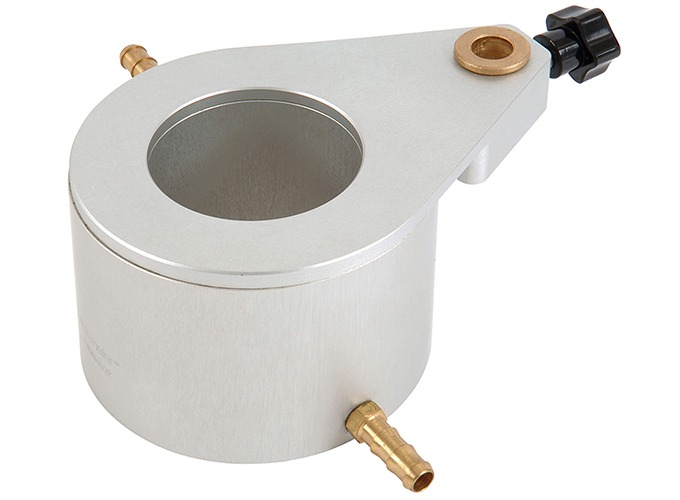
As temperature can have a significant effect on liquids, including paint, it is imperative that the intended temperature be maintained through the calibration process or during the use of the cup to conduct viscosity measurements on a liquid. For this purpose, it is suggested that the user adopt the use of Double-walled Thermojacket whereby water at a constant temperature is pumped through the wall to maintain the liquid under test.
The common temperatures for calibration are 23 degrees Celsius (ISO standard) and 25 degrees Celsius (ASTM standard).
Newtonian & Non-Newtonian Fluid
In terms of behaviour, liquids are classified as either Newtonian (named after Sir Isaac Newton) or Non Newtonian. The viscosity of a Newtonian fluid does not change with a change in the Shear stress as long as the temperature remains constant. A common example of this is water. No matter how much shear stress is applied (for example when the water is stirred), there is no change in its viscosity.
The viscosity of a Non-Newtonian liquid varies when subjected to different Shears. An example is Yoghurt: when it is stirred, you will notice that it becomes less viscous.
What is Shear?
Shear is what happens within the liquid when a force is placed on it. The force could be in the form of gravity (for example when pouring a liquid from a container). Shear is also created at the wall of a tube through which the liquid flows; the fluid close to the surface of the tube tends to cling to the wall of the tube while the rest of the fluid flows past it. In the same way, shear is created when a liquid passes through the orifice in a viscosity cup or it comes out under pressure through the orifice of a spray gun.
Types of Non-Newtonian Liquid:
1. Thixotropic: When a force is applied, the viscosity of the liquid decreases and the liquid becomes “thinner”. After the force (for example from stirring) is stopped, the viscosity returns to the level it was before. Honey is an example of a thixotropic material. We also see this in many types of paint; during application (by spray, roller of brush), the viscosity of the paint is reduced through the shearing action; but after the paint attaches itself to the surface, its viscosity increases and achieves the desired film formation and film build and the brush marks are significantly reduced.
2. Rheopectic: When a force is applied to this type of liquid, its viscosity increase. An example of this is cream.
3. Pseudoplastic: Also known as “shear thinning” as the viscosity is reduced when the material is subjected to a force. The change in viscosity is more rapid than for thixotropic materials. An example of a pseudoplastic material is tomato ketchup. A shake of the bottle makes the ketchup much easier to pour in the shortest time.
4. Dilatant: this is called “shear thickening” as the viscosity increases when a force is applied on it. An example of this is a mixture of corn starch and water which is often called “Oobleck”;
Flow Measurement
Sometimes it is necessary to conduct Flow Measurement to determine the fluidity of paints and inks. There are two types of instrument for this purpose.
In the Matthis Fluidometer, the paint material is poured into a semi-spherical cavity at the top of the gauge. This gauge is then lifted from the horizontal to the vertical position to allow the paint to flow down the tube. When all the sand in the timer (which is attached to the gauge) has fallen to the bottom of the chamber, a record is made of the distance travelled by the paint.
Daniel Flow Gauge
A quantity of paint is poured into a reservoir in the gauge while it is in a horizontal position. The gauge is then lifted into a vertical position and a recording is made of the distance travelled by the paint on the horizontal plate after 10 seconds.
Daniel Flow Gauge
There are two types of viscosity: Kinematic and Dynamic.
Dynamic Viscosity (also known as Absolute Viscosity) is the resistance offered by a liquid when it is subject to an external force; for example pumping a liquid through a pipe. The standard unit of measurement is centipoise (cP).
1000 cP is equal to 1 Pascal-second (Pa.s) and 1 cP is equal to 1 mPa-S (MilliPascal-S).
Kinematic viscosity measures a fluid’s resistance to flow when no external force, except gravity, is acting on it. A drop of honey on a flat surface spreads out slowly because it has high resistance to flow while a drop of water on the same surface spreads very quickly because it has a much lower viscosity with low resistance to flow.
The unit of measurement for Kinematic Viscosity is the Stoke (St). However, it is more common to use the smaller unit of measurement centistoke (cSt). 100 cSt = 1 St.
The relation between Dynamic and Kinematic viscosity is given by the formula:
Dynamic Viscosity = Kinematic Viscosity/Density
Dynamic viscosity is also known as Absolute viscosity.